Each of the four evangelists gives us details about Jesus’ passion and death that we do not get in other gospels. Mark is often thought to be the young man he mentions in his Gospel in Gethsemane who fled when Jesus was arrested (Mark 14:51-52). Mark was not an eyewitness to what he described; he wrote his Gospel in Rome using Peter as his source, so his Gospel has credibility. Luke also was not an eyewitness, and makes it very clear at the beginning of his Gospel that he compiled his Gospel from multiple sources (Luke 1:1-4), and since he accompanied Paul on some missionary journeys (Acts 16:10-17; 20:5-15; 21:1-18; 27:1-28:16) his Gospel was accepted into the New Testament. But John the evangelist saw what he wrote about. He begins his first letter:
What was from the beginning,
what we
have heard,
what we have seen with our eyes,
what we looked
upon
and touched with our hands . . .
what we have seen and
heard
we proclaim now to
you. (1 John 1:1, 3)
The extra details in John’s Gospel are eyewitness details. I want to focus on one of them, what Jesus was wearing during his passion.
The soldiers divided Jesus’ clothes into four shares, one share for each soldier. They also took Jesus’ tunic but decided not to divide it. Instead, they cast lots for it because it was a special tunic. What was so special about it? John tells us it was seamless, in other words, woven in one piece from top to bottom.
Jesus went directly from the Last Supper to Gethsemane and went directly from there to judgment before the Sanhedrin. Then, he was imprisoned for the night, and the following morning was judged before Pilate, and then went to Calvary. So Jesus was wearing this special tunic all the time from the Last Supper until Calvary.
It was common for homes at that time to have a small weaving loom for the woman of the house to make clothes. (see Prov 31:10-31) We can presume that Jesus went to his passion in clothes made for him by his mother Mary and she made a very special tunic for him.
 Many items in John’s Gospel are symbolic, so
John says two things at once. What was symbolic about Jesus’
seamless tunic woven in one piece? The Jewish high priest’s tunic
was seamless. So, John is telling us that Jesus is a priest, not a
Jewish high priest, but a priest of another kind. A priest’s role is
to offer sacrifice. During Mass, we offer bread and wine to God in
sacrifice. That’s why we call them gifts; they are gifts to God. The
Jewish high priest sacrificed animals. Jesus sacrificed himself for
us. He is the high priest of the New Covenant. He was the priest and
sacrificial offering at the same time. Our second reading today from the
Letter to the Hebrews described Jesus as our high priest and does so
at least twenty times in the course of the letter. One example is
“he had to become like his brothers in every way, that he might be a
merciful and faithful high priest before God to expiate the sins of
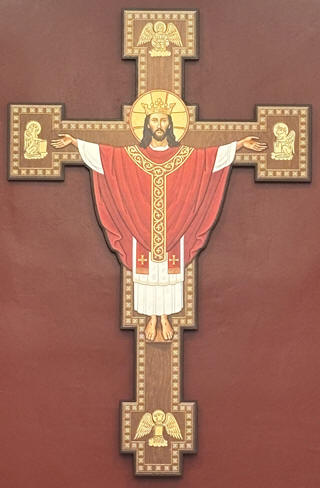
the people.” (Heb 2:17) You may have seen a crucifix with Jesus on
it dressed as a priest, with a white alb and red chasuble. While Jesus
was not dressed like that on the cross, those crucifixes express our
understanding of Jesus as our high priest of the New Covenant. There
are many different prefaces that we can pray before the eucharistic
prayer. The preface is the short prayer ending “Holy, Holy, Holy.”
The fifth preface for Easter contains this explanation of Jesus as
our priest:
Many items in John’s Gospel are symbolic, so
John says two things at once. What was symbolic about Jesus’
seamless tunic woven in one piece? The Jewish high priest’s tunic
was seamless. So, John is telling us that Jesus is a priest, not a
Jewish high priest, but a priest of another kind. A priest’s role is
to offer sacrifice. During Mass, we offer bread and wine to God in
sacrifice. That’s why we call them gifts; they are gifts to God. The
Jewish high priest sacrificed animals. Jesus sacrificed himself for
us. He is the high priest of the New Covenant. He was the priest and
sacrificial offering at the same time. Our second reading today from the
Letter to the Hebrews described Jesus as our high priest and does so
at least twenty times in the course of the letter. One example is
“he had to become like his brothers in every way, that he might be a
merciful and faithful high priest before God to expiate the sins of
the people.” (Heb 2:17) You may have seen a crucifix with Jesus on
it dressed as a priest, with a white alb and red chasuble. While Jesus
was not dressed like that on the cross, those crucifixes express our
understanding of Jesus as our high priest of the New Covenant. There
are many different prefaces that we can pray before the eucharistic
prayer. The preface is the short prayer ending “Holy, Holy, Holy.”
The fifth preface for Easter contains this explanation of Jesus as
our priest:
By the oblation of his Body,
he
brought the sacrifices of old to fulfillment
in the reality of
the Cross
and, by commending himself to you for our salvation,
showed himself the Priest, the Altar, and the Lamb of sacrifice.
There were many Jewish priests in the Old Covenant. There is one priest in the New Covenant—Jesus. We all share in his priesthood—everyone shares in the priesthood of Jesus through baptism since we are called to sacrifice ourselves to God. Paul wrote to the Romans, “I urge you therefore, brothers . . . to offer your bodies as a living sacrifice, holy and pleasing to God, your spiritual worship. Do not conform yourselves to this age but be transformed by the renewal of your mind.” (Rom 12:1-2) Ordained priests share in the priesthood of Jesus in a special way to minister to all of you who share in the priesthood of Jesus through baptism.
Today, being very conscious of Jesus’ priestly sacrifice for us, that he is our priest, altar, and lamb of sacrifice, we thank him for the salvation he gained for us. Jesus had his tunic removed when they crucified him. Spiritually, we are to put on Jesus’ tunic. Paul wrote to the Galatians, “For all of you who were baptized into Christ have clothed yourselves with Christ.” (Gal 3:27) In his letter to the Romans, Paul wrote, “Put on the Lord Jesus.” (Rom 13:14). In his letter to the Ephesians, Paul wrote, “you should put away the old self of your former way of life, corrupted through deceitful desires, and be renewed in the spirit of your minds, and put on the new self, created in God’s way in righteousness and holiness of truth.” (Eph 4:22-24) We thank Jesus that he is our priest, altar, and lamb of sacrifice. He had his tunic removed, and spiritually we are to put on Jesus’ tunic, a new way of life.
(There is a beautiful little book with meditations on Jesus’ tunic, Revêtir le Christ: Sept méditations devant la Sainte Tunique by Fr. Cariot)
© Fr. Tommy Lane 2026
This homily was delivered in a parish in Ireland.
More Homilies for Good Friday
Behold the wood of the cross 2024
Within your wounds hide me 2022
Blood and water from Jesus’ side giving us life 2015
The Passion of Jesus moves us to repentance
Related Homilies: Mary stood beside Jesus’ Cross 2023
Jesus’ trials before the Sanhedrin and Pilate 2021
Pierced hands and feet predicted by Psalm 22 2020
Jesus took our sins on himself 2018
Jesus on the cross teaching us how to respond to unjust suffering 2015
St. Teresa of Calcutta’s spirituality (Jesus on the Cross, “I thirst”) 2012
The Passion of Jesus shows us up as sinners and heals us
The miraculous crucifix in Limpias
The Sudarium, the Face-Cloth of Christ
Jesus’ sufferings revealed by the Turin Shroud
See Office of Readings, Easter Week IV, Tuesday, Second Reading
Jesus paid the price for our sins
St Margaret of York, Eucharistic Martyr, martyred on Good Friday